From MVP Friction to Product Strategy ● Investments
- Gabriela Tvardowski Altmann

- Feb 25
- 3 min read
Updated: Mar 6
Company: RecargaPay | Role: Senior Product Designer | Scope: Product Strategy, UX Research, Experience Design | Timeline: 2025–2026 | Impact: CX contacts ↓ 14%

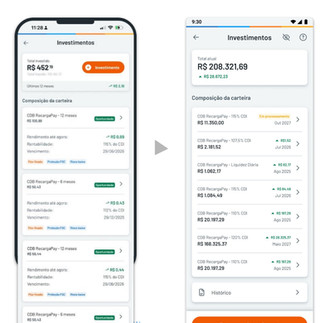
I led the strategic conception of Investments V2 at RecargaPay, creating an executive product document to align product vision, business opportunities, and experience decisions before development.
After the launch of the V1 MVP, product signals revealed structural friction across the investment journey. Adoption patterns and behavioral data indicated the need for a strategic reassessment.
Rather than a simple redesign, the challenge was to reframe the product strategy based on metrics, user behavior, and business goals.

Product Signals & Strategic Diagnosis
Data window: First 3 months after product launch
Product metrics revealed a structural shift in user behavior.
While total invested volume decreased slightly (-15%), the number of investment operations more than doubled (+107%) and the investor base grew by +55%.
These signals showed that the product was attracting new retail investors, but with smaller ticket sizes, highlighting the need to improve clarity and perceived value.
At the same time, redemption volume decreased by 46%, indicating stronger capital retention once users committed to investing.

Executive Strategic Document
The first deliverable was a strategic product document designed to support executive decision-making.
The document consolidated four key dimensions:
1. Current Product State
Adoption and engagement metrics
Behavioral signals across the investment journey
Friction points identified in critical flows
2. Market Benchmark
Analysis of investment experiences across leading fintechs
Comparison of interaction patterns, information hierarchy, and decision support mechanisms
Identification of product opportunities and gaps in the current experience
3. Strategic Hypotheses for V2
Experience improvements explicitly connected to business metrics:
Activation
Conversion
Recurrence
4. Risks & Constraints
Technical complexity
Regulatory constraints
Cross-team dependencies
This framework enabled a more structured discussion with leadership, reducing subjectivity and aligning expectations around scope, impact, and prioritization.
Usability Validation (Maze Testing)
Method: Unmoderated usability test | Tool: Maze | Format: Asynchronous | Distribution: Email test link | Environment: Mobile prototype
To reduce product risk before implementation, I conducted an asynchronous usability validation using Maze.Participants accessed the prototype through a testing link distributed via email, allowing them to complete the test independently in their natural context.
The objective was to evaluate:
• Clarity of the investment value proposition
• Discoverability of primary actions
• Cognitive load across the investment journey
Participants completed the tasks remotely, generating behavioral data such as path navigation, misclick patterns and interaction heatmaps.
Key Results
Results revealed meaningful friction

Heatmap analysis revealed high exploration behavior and clusters of misclicks around investment options, suggesting friction in information hierarchy and action discoverability.
Users frequently explored multiple elements before identifying the correct action, indicating uncertainty during the investment decision flow.
These findings reinforced the need to simplify the investment journey and introduce stronger contextual guidance.


AI-Assisted Research Workflow
AI tools were integrated across the usability testing process to accelerate research synthesis and insight generation.

AI supported the workflow by:
• Structuring research questions and test scenarios
• Organizing qualitative responses from participants
• Identifying behavioral patterns and misclick clusters
• Producing synthesis summaries for stakeholders
This approach reduced analysis time and improved the speed of insight sharing across product teams.
Strategic Direction for V2
Based on product signals, usability insights, and business priorities, Investments V2 focused on three strategic principles:
Clarity
Simplifying financial concepts and investment mechanics to improve user understanding during the decision process.
Confidence
Providing contextual information to support informed investment decisions and increase user trust.
Discoverability
Improving navigation and action hierarchy to make key investment actions easier to find and execute.
These principles guided the redesign of the investment journey and informed the phased implementation strategy.
Operational Impact
Beyond product experience, operational signals also informed the strategic direction.
One improvement delivered in the first release phase—investment scheduling for non-business days—reduced CX contact volume by approximately 14%, demonstrating how experience improvements can also drive operational efficiency.
Role & Contribution
In this initiative, I operated beyond execution-level UX, contributing to the product at a strategic level.
My role included:
• Analyzing product metrics and behavioral signals
• Conducting competitive benchmarking across fintech platforms
• Structuring the strategic product document presented to leadership
• Planning and executing usability validation
• Defining the experience direction for Investments V2
• Supporting the phased delivery strategy with product and engineering
This work positioned design as a strategic partner in product decision-making, connecting user experience improvements with business outcomes and operational impact.